House Rabbit Community and Store

What are we about? Please read about our Forum Culture and check out the Rules.
The subject of intentional breeding or meat rabbits is prohibited. The answers provided on this board are for general guideline purposes only. The information is not intended to diagnose or treat your pet. It is your responsibility to assess the information being given and seek professional advice/second opinion from your veterinarian and/or qualified behaviorist.
› FORUM › HOUSE RABBIT Q & A › What breed!?!?
I have had Loki for almost a year now and I still cannot decide whether he is mixed with English Spot or Rhinelander. The two are so similar it’s hard for me to tell. He’s my first rabbit so i’m hoping maybe someone with more experience in different breeds could help! There’s no denying he’s lionhead (his mane/mohawk) I’ve heard both English Spot & Rhinelander rabbits are difficult breeds. I wouldn’t say Loki is necessarily difficult.. but he’s quite the trouble maker! Loves to dig, chew, would rather run off and do his own thing rather than be loved. He loves time with me too but isn’t nearly as affectionate as I heard some other’s rabbits are. He also definitely has a temper. he’s been neutered since March but he still gets EXTREMELY territorial. (I’m talking don’t even think about touching what’s his.) When I walk away from him or leave the room for a minute, he goes into destruct-o mode. I also cannot leave anything important at his level, it will be destroyed. My point being, I’ve really been trying to figure out whether it’s one of the two breeds and I just can’t decide. He’s also pretty arched compared to rabbits i’ve seen; if that helps. I attached links of him so hopefully they work! let me know what you think!
He’s such a handsome bun ![]()
**and i’m sorry, he’s 3.5 pounds.
http://s1194.photobucket.com/user/lokipokes/media/IMG_5034_zpsonrroqvv.jpg.html?sort=3&o=0
http://s1194.photobucket.com/user/lokipokes/media/IMG_4962_zpst4rba5gi.jpg.html?sort=3&o=1
Loki is on vine a little too,
https://vine.co/u/1120526626770587648 ![]()
Possessing the “English Spot” or broken gene doesn’t necessarily mean a rabbit has lineage in a particular breed. The broken gene is a complicated gene that has been introduced into a variety of breeds. This includes lionheads. It’s hard to tell how big your bunny is, but he could be a lionhead that didn’t meet breed standards. Anyway, he’s super adorable. He could very well be going through a teenage-phase. Most bunnies change as they get older, growing into their adult personalities. That’s why we say to adopt an adult rabbit if you don’t like surprises. Hehe! The surprise can be part of the fun though and many people enjoy getting a baby bunny and watching him/her blossom. The trick is learning to love them for who they become, whether affectionate or not so much. Trust me, I know that’s not easy. I too fell in love with a sweet baby bunny that needed a home. He’s a little brat now at 5 years old. ![]()
His hair is long around his ears suggesting some lionhead in there. He does not appear to be dwarfed.
Though as LBJ10 points out, the spot pattern is common in a variety of breeds, his fully arched shape does also fit english spot. Though again, many breeds are fully arched, so not that conclusive.
What does he weigh?
Yes, how big is he? That might help a bit.
He’s such a handsome bun
Is he ever!
I think lionhead is about as close as you’ll get to knowing what’s in his mix. The coat pattern is not pointing to any particular breed. He could be part lop or part an uppy-eared bun.
he’s 3.5 pounds, sorry I forgot to list such an important factor!
The things that point me to English Spot is the marking he has down his spine, the spots on the side, and the face too. which is really everything, but from what i’ve read, English Spots tend to have 1 color. You can’t tell in pictures but Loki is mainly black, gray, mixed with some chocolate brown. But again, being that he IS mixed with something else (lion head) he could be getting the numerous colors from that side possibly?
Yes Loki has definitely changed so much since I’ve gotten him. He used to be terrified of everything, including me! Now he’s really a momma’s boy. People come over to see him and he hides behind me, instead of running to see them he just comes over to me
But still really isn’t very affectionate but it’s fine. He’s gotten so much better with me that I look forward to the future. Believe me I love that boy more than anything! I wouldn’t change him for anything!
What a cutie pie!
He definitely looks like he has some lionhead in there. Like the others were saying, broken coloration is pretty common in many breeds of rabbits. But If I had to choose between whether he looks more like an English Spot or a Rhinelander I’d say he looked more like an English Spot. The pics I was looking at for Rhinelanders looked pretty similar to english spots, but their spots/stripes were 2 colors, almost like a calico or brindle color.
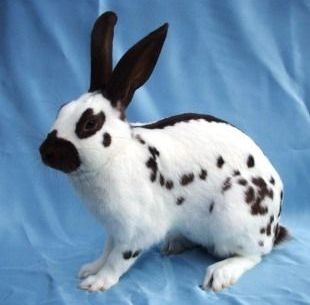
English spots have a stripe all the way down their back, colored eats, around eyes/mouth, cheek spots, spots running down their sides and for a good “specimen” of the breed, spots on their “elbows”. Like so:

What was interesting though, Loki does have color around his ears/eyes/nose, does have a cheek spot, does have somewhat of a stripe and spots going down his sides. So it’s not impossible he has English spot, or even Rhinelander in him.
Loki does have little spots on his elbows too. But the thing you can’t tell unless you see him in person, is that he IS multiple colors. He isn’t just grey. All of his spots have a chocolate-brown color as well. It’s changed a lot since he was a baby. He started off only grey- almost black, and now he’s grey with brown. Which makes me think possibly rhinelander, but he could be getting other colors from his lion head side- who knows! haha I wish there was someone I can take him to that could determine what he is! I’d love to know! I love that little bugger.
The “english spot” or broken gene can produce a wide variety in the amount of white. The spotting pattern is pretty much the same, the amount of white is what varies. It’s difficult to explain, but the white starts at the belly and feet and then progresses upward. So a bunny with the broken gene could have only a little bit of white pattern, but the white will be on the belly and feet. A bunny could have a medium amount of white, so white feet, belly, and up the sides a bit for a blanket look. Less white and spots start to define, as well as butterflies and cheek spots. Even more white and all that is left with color is the nose, ears, and a line down the back. These all fall within the broken gene pattern. In fact, sometimes bunnies will have so little white they look like Charlies, but they are not genetically Charlies. The pattern has nothing to do with color. The pattern has to do with how much white there is. Wow, that was long. Hopefully my explanation makes sense. LOL
Anyway, my point is that at 3.5 lbs, I’m doubting English Spot or Rhinelander are in the mix. They are pretty big bunnies (8-10 lbs). The broken gene in lionheads is the same broken gene in English Spots and Rhinelanders. So I’m still thinking lionhead that doesn’t meet “breed standards” or a lionhead mixed with another smaller breed bunny. The fact that he has cheek spots or a particular pattern really doesn’t mean anything because it’s the result of the broken gene and how much white there is.
When you say his spots are grey and brown, do you mean some spots are grey, and other spots are brown? Or, do you mean the the individual hairs have grey and brown banding? Or, he has longer brown guard hairs, mixed in with shorter grey undercoat hairs?
Eepster – if you zoom in you can see it looks like black with lighter guard hairs.
Pattern-wise, a broken otter of some description, perhaps? Think I can see little tan colour around nose and eyes.
Broken gold tipped steel?
Broken harlequin?
Lol!!!
I need look at pics on PC.
I tried taking some pictures with the flash on to show you guys better. it’s hard to tell in pictures, in person and in the sunlight is when you can really see the brown in him. What I mean is all of the spots he has, are mixed with brown hairs as well. They’re mainly grey, with some brown mixed in.
here are the pictures:
http://s1194.photobucket.com/user/lokipokes/media/IMG_5322_zpsz3kjm30g.jpg.html
http://s1194.photobucket.com/user/lokipokes/media/IMG_5420_zpsjkmn4r8z.jpg.html
http://s1194.photobucket.com/user/lokipokes/media/IMG_5419_zpsk3aqxphb.jpg.html
when you guys use the term “broken” what does that mean? not full breed?
From what I’ve read/seen/heard, the term “broken” means that a rabbit doesn’t have a full color pattern. For instance, a fawn Holland Lop is completely fawn. If they have “broken” spots of white, then they have a “broken” pattern? Someone, correct me if I’m wrong… I’m not completely positive of my answer.
Cinnybun – No, you’re correct. Broken is a pattern. It has nothing to do with breed. Like my Leopold. He’s a Holland lop. His main color is black, but he has the broken gene (A.K.A. the English spot gene…. it’s the same gene, but people call it different things). The broken gene produces areas of white. So if Leopold did not have the broken gene, then he would be solid black. The amount of expression varies and in Leopold’s case, he has >50% black so he is referred to as having a blanket (less than that and he would be spotted). He’s still a Holland lop though. I don’t believe anything else is mixed in there. But you see broken Hollands all the time.
Mandy – Those pictures are much better. Definitely looks like agouti and steel in there, so maybe black gold tipped steel is his main “coloring” and then he has the broken gene as well. You do see broken lionheads, so that’s why I said pattern alone doesn’t really tell us much. He could possibly be a purebred lionhead that did not meet breed standards (i.e. he doesn’t have a full mane) or he could be a lionhead mixed with another small breed.
The blending of the two colors Loki has in his spots isn’t considered two separate coat colors. It is considered a single color “agouti.”
The tricolor of rhinelanders means they have three completely distinct and separate colors.
› FORUM › HOUSE RABBIT Q & A › What breed!?!?