House Rabbit Community and Store



What are we about? Please read about our Forum Culture and check out the Rules.
The subject of intentional breeding or meat rabbits is prohibited. The answers provided on this board are for general guideline purposes only. The information is not intended to diagnose or treat your pet. It is your responsibility to assess the information being given and seek professional advice/second opinion from your veterinarian and/or qualified behaviorist.
› FORUM › THE LOUNGE › Question for all dog owners (and anyone who wants to weigh in of course)
- This topic has 16sd replies, 9 voices, and was last updated 17 years, 4 months ago by
 KatnipCrzy.
-
AuthorMessages
-
-
04/30/2009 at 2:36 PM
Ok can you tell I’m getting excited about our new doggie??

I did find a dog/cat forum to check out info on diet-I’d like to do the right thing with food and although I don’t agree with raw food diet-I wanted to read more on it. Got me stumbling upon people who do NOT vaccinate their dogs
 WHAT?? I posted politely asking why…these people are all huge raw food-know more then vets-kinda people but maybe their is something behind it…
Someone suggested the first puppy vaccines are good but after that not to vaccinate
So many of you have dogs, and Katnip I’d love your opinion alot too since you work in a vet clinic…
1) Do you vaccinate your dogs -and do you do it every year?
2) If not, why not? Any particular vaccines you do do-and don’t do?
-
04/30/2009 at 2:53 PM
Congrats on the new pup!! I am a vet tech in the Chicagoland area and one trend we have seen is that people are opting to have the titers for the disease checked (a yearly blood check) before vaccinating. Vaccine companies have commonly only tested vaccine efficiency for a 1 year time period, thus they cannot say how long the actually last. Because of this, they are labeled as being necessary every year. There are some outside studies that have been done that prove that these vaccines are effective much longer and that we are actually overvaccinating our dogs/cats. For obvious $$ reasons, the vaccines companies do not want this to change and vets have to follow FDA regulations!! If you think about human vaccines, we need more (which is also in question) as infants and fewer as we get older – same concept in being discussed in vet medicine. Puppy vaccine up to 6 months, usually ending with rabies are definately necessary – it is after that point that is in question. Legally, the first rabies vaccine has to be a 1 year vaccine. After that, it depends on the state you live in (not sure about how that works in Canada!!). This is something you should discuss with your vet. Another issue is with some of the newer diseases – ie Lyme’s – the vaccine is only like 60% effective. So if you are not in a high risk area, you’re really not gaining much!!! I hope this isn’t too confusing!! I’m in a bit of a hurry, but will try to post more if you have ??!!
-
04/30/2009 at 2:55 PM
I used to work for a child care centre and one of the parents was a vet lecturer, he said you need to vaccinate your dog every year until about the age of 6 or 7, after this time he said they have built up a resistance to diseases, after that age you can vaccinate every couple of years and then by the age of 10 or 11 he said you would not have to do it anymore.
I don’t vaccinate my 13 and 14 year old anymore.
He only vaccinates his dog every couple of years so that was good enough for me.
One of the reasons they want you to vaccinate every year is because that is where they make most of their money from.
-
04/30/2009 at 2:57 PM
Puppy vaccines are a must but after that the only required vaccine is rabies. For the others you can get yearly titers, which will measure the amount of antibodies in your dog’s system. If there are enough there’s no need to vaccinate. If there aren’t then usually vets will provide the vaccine without charging another office visit. Bordatella is only needed if your dog will come in contact with a bunch of other dogs or if he or she will be boarded. If you’ll be boarding your dog you might need vaccines instead of titers because many kennels don’t accept titers.
As far as food goes…for the first year a puppy food high in protien is best. You want your first three ingredeints to be a named meat source, you want to avoid corn and rice and brewers rice (trash left over from making beer), and any kind of by products. Beef is generally an allergen for dogs and chicken meal and lamb meal are good meat sources, they’re more concentrated than regular listed chicken or lamb.
Good brands of dog food are Innova Evo, Chicken Soup, Wellness (though this can be a little rich and cause tummy troubles) Fromm, Canidae, Solid Gold, Nutro Ultra…some of these can be found at Petco, most of them can’t be found at Petsmart. They cost more but you feed less because it’s more nutritionally valuable.
:0) Dogs are kind of my passion.
-
04/30/2009 at 4:34 PM
Ok, natural feeding people are very opinionated!! I agree with some stuff, some other things I don’t. For a dog I don’t totally agree with a raw diet just due to the fact that they have been domesticated and bred so long they don’t seem to really have the exact same digestive system as a wolf. About vaccinations…
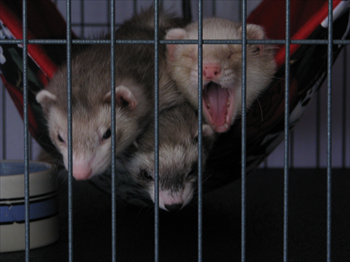
Dogs (after puppy shots) only need the rabies vaccine every three years I belive. Titers are a good idea too! With ferrets there is a big agrument going on about vaccinating and not vaccinating yearly. Supposedly a vaccine for them can last three years, but it’s not proven. Chewie will not being getting vaccinated since as far as I know he’s never been vaccinated and he’s old. It’s very likely he could react to the vaccine and die. My other two ferrets will be getting titers unless I show Ember (they require that they are UTD on shots if you show them).
About food TARM suggested some really good foods, but be careful about Nutro. They are being investigated about some deaths caused by their food. CA Natural and Orijen are also great (expensive!) brands! If you do become interested in raw feeding I would try commercial raw. Here’s a good place to get the food (even though it’s based on ferrets, the food is meant for dogs, cats, ferrets, etc.)
http://caseyshiddenpantry.com/Along with the patties though I’d supplement some veggies (possibly), but if I were you I’d do lots of research about it!
-
04/30/2009 at 4:40 PM
When my dog was just a small puppy (had 1st pup vaccine but not fully vaccinated) my rents took her outside to do her business as they didn’t have a backyard (just apartment) and she ended up sniffing another dogs feces (heck, all dogs do that) and that night she had tons of blood in her stools and so she had to go to the emergency vet, stayed overnight as she nearly died (vet was certain she wouldn’t make it..) but thankfully she did. Sorry idk much about dogs
…. but I asked my dad and he said we do “Distemper”,”Parvo”, and of course rabies each year. -
04/30/2009 at 5:08 PM
I did not know that about the Nutro…I fed my dogs Blue Buffalo for a while, then all of a sudden it started making them really sick. Puking, the runs, all that nasty stuff. I was wondering if they got some of that bad corn.
-
04/30/2009 at 5:17 PM
Yeah I just found out about Nutro a couple days ago! It’s supposed to be a really good quality food. Guess not anymore :-P! Hmm yeah Blue Buffalo’s supposed to be good too. Maybe animals just react differently to different food? Oliver doesn’t do well on kibble, but Ember does. Chewie does ok, but not great (upsets his stomach sometimes). Animal nutrition facinates me, lol!
-
04/30/2009 at 5:19 PM
my dogs ate Blue Buffalo for almost a year before it started making them sick. That’s why I think they did something to it.
-
04/30/2009 at 6:34 PM
Both my dogs are elders, so they only get the rabies vaccine and that only every three years. Must check their paperwork…I think they are both due. 0_o
You all know the recent troubles I’ve had with my two dogs and how we’ve had to switch them both to a non commercial food diet and specified exercise routine. I think as long as they get some real meat in their food and not too much soy or corn, or by products, whatever brand of food you find is good for them. Right now Shadow and Taiku only get some Purina lamb and rice cans, plus some ID (science hills) and we always boil chicken breast for them. They get two meals a day instead of one big one and only walks either one hour before or two hours after eating to prevent any chance of bloat and torsion.
I found one dog forum after Shadow’s bout with bloat, but they are not as responsive as we are here. They did recommend the following book:
Dr Earl Mindell’s Nutrition and Health for Dogs
I got it and it’s a good read. ^_^
What kind of dog did you get Lesley? I don’t recall seeing the breed. Big chested dogs are prone to torsion. After seeing my older dog go through it, I never want to think of any dog in that kind of pain again. It was horrible.
-
04/30/2009 at 7:18 PM
Congrats on the new puppy!
I have all my dogs rabies and yearly titers other than that no vaccines unless it is a new puppy.
I feed 2 of my dogs RAW and quite honestly they look and feel so much better than my kibble fed dogs they are not fed a prey model diet (meat and bone only) they have vegetables and all that with theirs. As far as kibble goes I feed grain free (unless I have a large breed dog) right now mine are on a rotation of EVO, Taste of the Wild, Orijen and Wellness Core.
When I have puppies they are also fed either EVO or Taste of the Wild since they are an all stages food. If I have a large breed I usually feed something like Merrick puppy plate or California Natural.
I loves doggies
I have 7 and want 4 great danes at my local shelter lol -
05/01/2009 at 5:03 AM
There are four great danes at your shelter? *swoon*
-
05/01/2009 at 7:35 AM
Posted By TankAndRangersMom on 05/01/2009 05:03 AM
There are four great danes at your shelter? *swoon*Yep but they won’t be there long they don’t really last in shelters here since people use them as outside guard dogs. They would be inside giant pillows for me LOL.
-
05/01/2009 at 7:36 AM
ugh…Outside guard dogs?
poor poor puppies. :0(
-
05/01/2009 at 9:17 AM
K&K-
Your dog is a young adult dog correct? Concerning the most common vaccine (Distemper)- My vet clinic is giving the Distemper portion every 3 years once the dog has been immunized against it thru puppy booster and gotten some yearly adult boosters of it. But there are other portions of the vaccine that do not seem to last for 3 years- such as the Leptospirosis which is included in our vaccine- so the dog still does needs a yearly vaccine- but they are not getting “all” of it every year. What is referred to as the Distemper vaccine usually has other immunizations that the vet feels should be included- parvo, corona, lepto, parainfluenza, hepatitis. And it depends on the area that you live in- and what your vet recommends. Lepto is contagious to humans- so we booster that every year- and it is recommended for our area. (Some small dogs have a reaction to Lepto and are not vaccinated for Lepto)
So for the regards of vaccinating yearly- you need to talk to your vet and see what they recommend also- since the area you live in plays a big role in it. A blood draw can be done and titers checked- but that is more expensive than giving the vaccine- so we only rarely have a client that opts to do titers.
And concerning the rabies vaccine that varies state by state also- In Michigan and other northern states the first rabies vaccine is one year- and then each rabies vaccine is every 3 years after that. But it is different in other states like Florida where they require yearly rabies vaccines due to the higher risk environment. (This is regulated by law- not the vet clinics) And rabies is contagious to humans so they have stricter guidelines- and rabies is the only vaccine required by the State of Michigan- and you need proof of rabies to get a yearly license for your dog. If you do not have one (many people do not)- if you get caught without one you get a ticket and then need to purchase the license anyway.
There are other vaccines like Lymes- which I do not give my dogs since I have never found ticks on them. But we do have ticks in our area and cases of Lyme have been reported. So if my dogs were getting ticks just from going into our backyard (which some of our clients report)- then I would consider that vaccine.
Bordetella or kennel cough vaccine- I do get this for my dogs since they visit the dog park. But for a dog that stays home, is never boarded and is not exposed to other dogs- it is not necessary. Kennel cough is a contagious upper resp infection that gets transmitted easily to many dogs when there is an exposed dog around many other dogs- boarding, doggy day care. dog parks, agility or frisbee competitions, etc.
Things might be different in Canada- I am not sure. But regardless even if a dog does not get a “vaccine” every year- the dog should still have an exam. I will post more on the food topic later!
Julie
-
05/01/2009 at 10:45 AM
Thanks so much for all the helpful info on vaccines everybody!!! I talked to my mom last night to ask how she thinks our vet would be, if I asked for titres first and possibly refused vaccines (he’s currently UTD on everything and is two) -and she said our vet would be fine with that
 (It’s important to me that she is, she’s my bunny’s vet and my shelter bunnies vet!!! She’s actually just come back after a month of specialist rabbit training
  Wonder if all the bunnies I force on her had anything to do with it LOL)
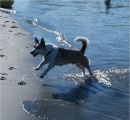
For those who asked-Petey who will become Mikey-is a two year old Corgi cross and we go pick him up finally tomorrow!! Only ten hours round trip

(Love all the captions you guys put on-I kept the pictures!)

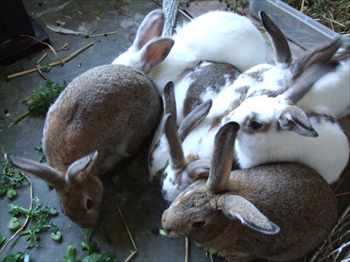
And they’ve been introducing him to rabbits

-
05/01/2009 at 2:18 PM
K&K-
When you are selecting a dog food- I would check and see what is available in your area. While you can buy dog food online- I would not suggest this as a first option because you will pay shipping and if you run out before you get your next order that will cause a disruption in their routine.
Dog nutrition is not an exact science- and there is a lot of debate on what is correct- raw diets compared to commercial kibble, etc. So you need to factor yourself into the equation- if you are not comfortable feeding raw meat- that rules that out. Also feeding homemade diets can be time consuming to prepare in advance, etc. And since you still need to feed high quality ingredients- I am not convinced that is it cheaper at all. Prepared diets are fed in a higher quantity than kibble- just like a cup of dry dog food equals more than 1 cup of canned food due to the higher water content in canned food.
Reading dog food labels is confusing and downright misleading. Many manufacturers to make their product look better list ingredients to their benefit. For example instead of listing that the first ingredient is corn- they will break it down into other acceptable categories like “corn meal” “corn middlings”- and by doing that it will make it look like there is more protein (chicken for example) than there is corn- when that is not precisely true. But unless your dog is allergic to grains- I don’t feel that it is bad to have some amount of grain in dog food- dogs are not such strict carnivores like cats are. (the laws in Canada might be different about pet food labeling)
I would look for a good quality kibble that is available readily in your area- and compare the ingredients and look on their websites and to see what your reaction is to the ingredients. Some dogs with allergies or sensitive tummies do better with limited ingredient diets- meaning there are fewer ingredients but the diet is still balanced. Some others have mentioned these foods but Solid Gold, Innova, California Natural, Evo, Eukanuba, etc are good diets.
This is personal opinion- but in general I do not like diets that are “for all life stages”- I feel that puppies, adults and senior pets DO have different nutritional needs.
So look at your lifestyle and yours and Daves preferences and decide what would work best. If you do not think you have time to deal with a diet that needs more prep than pouring in the bowl- then kibble is the answer. My husband will NOT feed canned food ever- so when I had to switch my diabetic cats food I went with kibble because it is pointless to have 1 out 2 people caring for the pet not onboard with what is being fed. And I would cook a homemade diet for my pets if I had to- if there was a medical benefit- but otherwise I would not want to deal with cooking meats, veggies, measuring supplements and portioning the meals.
Right before our cat was diagnosed with diabetes I was researching some diets made by “The Honest Kitchen” and they are dehydrated balanced diets that you reconstitute with water. They are a “raw” diet- but I just liked that ingredients that they put in- human quality ingredients that make sense- more so than the fact it was “raw”. And I think since it was dehydrated I could hand the fact that it was raw meat (I honestly almost never cook with raw meat- hubby does cooking). The only thing that I was tossing around with hubby is that it needs to sit for 20 minutes after adding water before feeding- and that would be a huge change for us- we usually feed around the same times but would have to get in the habit of preparing it first so it can sit.
I personally also give my pets some table scraps- and their tummies can handle it. It is a very limited part of their diet and not even something they get every day. I figure if they get human food now and then- when they do manage to sneak into it, it might be less likely to give them diah or vomiting. And I only give them stuff that not too fatty and not been sitting in the frig forever.
-
-
AuthorMessages







- You must be logged in to reply to this topic.
› FORUM › THE LOUNGE › Question for all dog owners (and anyone who wants to weigh in of course)