House Rabbit Community and Store
What are we about? Please read about our Forum Culture and check out the Rules.
The subject of intentional breeding or meat rabbits is prohibited. The answers provided on this board are for general guideline purposes only. The information is not intended to diagnose or treat your pet. It is your responsibility to assess the information being given and seek professional advice/second opinion from your veterinarian and/or qualified behaviorist.
› FORUM › HOUSE RABBIT Q & A › Odd poops
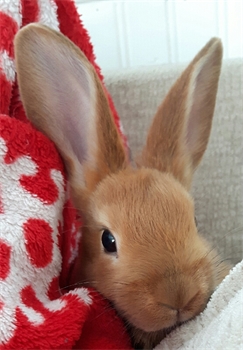
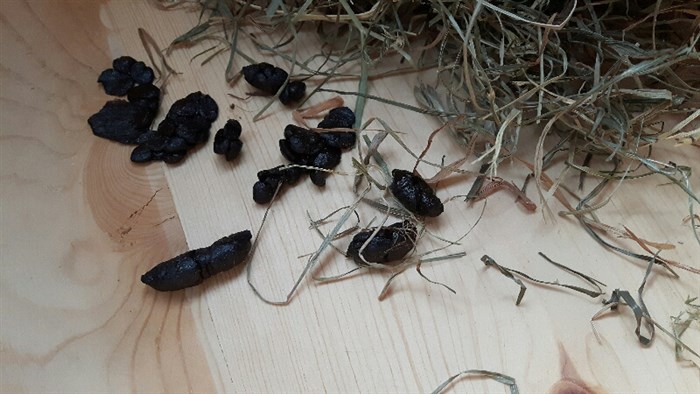
Hello bunny people. I’m very new to being a bunny parent, and I’m worried. I looked up general poop guides for bunnies and I’m not seeing anything that really lines up with what’s happening with Matilda right now. She’s 73 days old, I don’t know her breed, she has free access to all the water and hay she would like, she gets an 1/8th of a cup of pellets and a cup of mixed spring greens every day. She occasionally eats her little which is wheat based, but I’ve never seen that to cause an issue. She’s fairly perky and still chews on her favourite untreated Applewood toy. Please tell me if this is normal, or what I can do to fix it. 
Those are not normal, healthy droppings. Matilda is around 10 weeks old? It’s usually recommended that greens not be started until a rabbit is 12 weeks old, but I don’t know if that would be the problem. You say that she has access to hay at all times, but is she eating as much as she should? People generally give unlimited pellets to a rabbit that age, although you don’t want to overleed them. It might be a good idea for a vet visit, for a fecal check. I wonder if she could possibly have the condition called mega colon, but that is usually found in English Spot rabbits. Assuming that Matilda is the bunny in your avatar, she is not an English Spot. If she is eating plenty of hay, then the abnormal droppings probably aren’t due to her diet. Hopefully a good rabbit savvy vet can determine what is causing those droppings, and get her back on track with whatever treatment is needed.
Some of those poops look like uneaten cecals, which can happen if the bun’s diet is too rich, for instance.
You said she’s only two months old… Buns don’t usually get introduced to greens until 12 weeks, and even then, only in tiny quantities and very gradually in order to identify intolerances to particular fresh veg/leaves.
How much does she weigh? My Chewie is just shy of 2kg (4 pounds) and gets less than the recommended pellets because he just does better tummy-wise. Sometimes that’s an option to regulate poops.
Also, what kind of pellets are you feeding? And what kind of hay?
Adding a sprinkling of plain oats on the bun’s food can also help with tummy issues (but careful – they help add weight over time).
Matilda is the bunny in my photo. She is about ten weeks, and weighs 3lbs spot on. The old guy who I got her from fed her and her siblings whatever he was eating for dinner, meat, salad, pasta, everything. I’ve had her for almost a month, and I changed her diet to what it is now with no visible changes. I’ve read that I should free feed pellets at this age but she eats all of them right away, no matter how many I put down. The things she eats are Timothy Grass Hay, Oxbow Essentials Bunny Basics Young Rabbit Food made with alfalfa, and her litter which she seldom but sometimes eats is Original Swheat Scoop. She’s an avid snacker but leaves spinach alone as she doesn’t really like it. She also gets one small slice of banana if she comes and sits with me on the couch.
Oh wow, so glad she is on this much better diet. I just hope her siblings are as fortunate. It looks as thought there may be an inbalance in the cecum and that wouldn’t be surprising, given her former diet. I also recommend having a fecal & cecal test done. Cecal droppings do turn quite dark when dried out. I can see the normal grape-like cluster in some of those, but the one that’s big looks like unformed cecals which may be an issue.
It’s so good that she is on the diet you are giving her now. Swheat Scoop litter is one that is not recommended to use for rabbits. Here is an article we have at the sanctuary where I volunteer, regarding good and not so good litter for rabbits. It tells why you shouldn’t use Swheat Scoop.
What To Use In Your Rabbit’s Litter Box
Remember that rabbits may sit in their litter boxes for extended periods, and that they nibble on everything, so it’s important to choose the right litter.
Do not use cedar or pine shavings. These contain dangerous aromatic oils that have been found to cause liver damage and respiratory problems. Swheat Scoop Litter should not be used since rabbits will often ingest it. It is comprised of wheat, is very high in carbohydrates, and can cause obesity, excessive cecal production, diarrhea and other health issues. Don’t use clay litter. The dust causes respiratory problems, and if ingested, it is harmful to the digestive tract. Don’t use any clumping litters–if nibbled on, they are likely to cause obstructions in the intestinal tract. Also avoid corn cob litter. If eaten, it can cause a lethal intestinal blockage.
Recommended litters:
1. Newspaper, shredded or cut-up. It’s inexpensive and readily available, but it offers no odor control. If the newspaper is cut into larger pieces, urine may puddle at first until it is absorbed into the paper, which could cause your rabbit to have damp feet. It can be composted.
2. Paper pulp litter. It has low dust, good absorbency, and no hazards, though it also offers little odor control. It can be flushed or composted. Brands include Carefresh, Yesterday’s News, Cellu-Dri, and Eco Fresh.
3. Oat, alfalfa and wheat straw based pellets. Low dust, good absorbency, and no hazards, although they can cause bloating if too much is ingested. They can be flushed or composted. Brands include Critter Country, Cat Country, and Oxbow Eco-Straw.
4. Compressed sawdust (pine) pellets. Unlike pine shavings, these are safe, since they have no dangerous aromatic oils. They are economical, highly absorbent, and have good odor control. They may be composted. Brands include All Pet Pine, Feline Pine and Exquisicat.
5. Aspen bark, pellets or shredded. Highly absorbent, with good odor control. Pellets are economical, because it only takes a thin layer in the litter box. They may be composted. These larger pellets are good for long haired rabbits, since they don’t get stuck in their fur as easily as the small particle litters. Brands include Aspen Fresh, Gentle Touch and Aspen Supreme.
6. Straw or hay. Straw can be dusty and is not very absorbent, but has no hazards, unless it becomes moldy. Any of the grass hays can be used. Be sure to clean frequently, as your rabbit will also be eating the hay. It may be composted.
7. Wood stove pellets. These are compressed pine or hardwood pellets. Make sure that the pellets are plain and that they don’t contain accelerants. These are very economical.. They can be found in home supply or tractor supply stores.
8. Horse stall pellets. They are compressed sawdust (pine), also very economical. Found in feed stores, home supply stores, or tractor supply stores. One brand is Equine Pine.
If you change to a new litter, your rabbit may hesitate to use it. Mix some of the new with the old, or put some of the dirty litter into the new litter. Daily cleaning of the dirty areas is best. Regularly dump out the whole contents of the box, and thoroughly clean with an organic cleaner or a natural cleaner, such as white vinegar.
Many of these litters are available in pet supply stores, grocery stores, or discount stores. Litter, food and other rabbit supplies can be ordered online from drsfostersmith.com, wag.com, bunnybytes.com, petfooddirect.com, binkybunny.com, leithpetwerks.com, or various other pet supply catalogs and websites.

Good catch tobyluv! And thank you for the additional info.
@moonpearl, if you’re wanting to use up the rest of this litter, best to put a screen over it so she cannot eat any.
› FORUM › HOUSE RABBIT Q & A › Odd poops