The small bundle poo in your photo is called a “cecotrope” — this is a type of poop rabbits actually eat to fully absorb all the “good stuff” their diet provides. You can watch this video for an understanding of them: https://www.youtube.com/watch?v=7s-GhDknV1A&ab_channel=OxbowAnimalHealth … as well as read/see here for information on types of rabbit poop, their appearance/texture, and what that indicates: https://wabbitwiki.com/wiki/Rabbit_poop
Directly to your concern, if what you’re seeing is a lot of cecotropes, that is normal for a young rabbit on an alfalfa-rich diet (yes, alfalfa pellets is correct for her age). In an adult rabbit whose diet has no alfalfa, you will typically never see a cecotrope because they eat them directly from their bum. In young rabbits with alfalfa-based diets, they are getting a lot more nutrients/minerals (to ensure healthy growth) and that can lead to a production for excess cecotropes; therefore, they don’t eat all of them. As long as you’re seeing her eat some of them and they are not giving her poopy butt (see the WabbitWiki link for information on that), you do not need to be concerned about the cecotropes lying around.
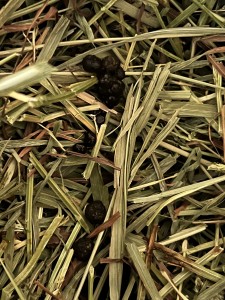
Speaking to her regular poo (i.e., not cecotropes; the single spheres that are generally uniform in size and vastly abundant), if you can crush it and it’s generally flaky/crumbly and you see plenty of hay specks, it is generally (probably) fine. The literal “golden poo” standard can be pretty impossible to achieve in some rabbits honestly– both of my rabbits have darker poo, and this can come from a variety of reasons that can also not be an issue health-wise. As best as I can describe as a stranger who can’t actually examine your rabbit (and am not a vet!), if there are plenty of poops made per day, the poos are uniform in size, shape, color, and texture, and you are confirming with your own eyes that your rabbit is acting and eating healthy (especially hay), I would say things are probably fine.
Did you slowly introduce all the veggies you’re providing her?
The answers provided in this discussion are for general guideline purposes only. The information is not intended to diagnose or treat your pet. Seek the advice of your veterinarian or a qualified behaviorist.



 .
.