How frustrating!
So, first, I would stop putting lavender and orange around the bun’s boxes. Bunnies (and cats) are very sensitive to aromatic compounds and lavender oil is harmful to cats and rabbits over time. Lavender in plant form is OK but the essential oils are very concentrated.
It may be necessary to block access to the bun’s litter boxes from the cat for a while to break this association. I think if you could pen your bunnies overnight while the cat is in the room, and then give them free-roam while your cat is in another part of the house that could help.
Are using the pelleted yesterday’s news? It also could help to use a different litter for your cat, one that he really really likes (such as a clay litter or some other “sandy” type).
I also think it would help a lot to use a litter box screen for the buns’ box, so your cat wont be able to dig and scratch in it. I use a screen, and have a layer of hay on top, and my cat ignores the bunnies’ boxes completely. Having the barrier of the hay layer over the screen breaks the association of it being a litter box for my cat.
I’m also not sure what style of litter boxes you have, but if the cat tends to use a covered one more, make that box his box, and then use the style he uses less for the bunnies.
Lastly, make sure your cat’s box is super clean. A lot of litter box issues with cats are tied to an unclean box, so cleaning his even twice a day should encourage him to use it. If your cat is not neutered that could also be increasing his tendency to mark.
The last thought I have, if all else fails, would be to do a complete re-arrange of everyone’s set ups and try to start fresh. Move the bunny set-up to a new area in the room, get bun a brand new litter box with a screen, clean the whole room with dilute white vinegar solution. Move your cat’s preferred litter box to the area where bun’s box used to be, and block access to your bun’s box until your cat’s box habits are really well established.
Hopefully something helps! Keep us posted on if you find a solution!
.
.
.
The answers provided in this discussion are for general guideline purposes only. The information is not intended to diagnose or treat your pet. Seek the advice of your veterinarian or a qualified behaviorist.



 .
.

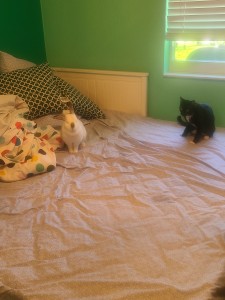 The Cabunny[/caption]